
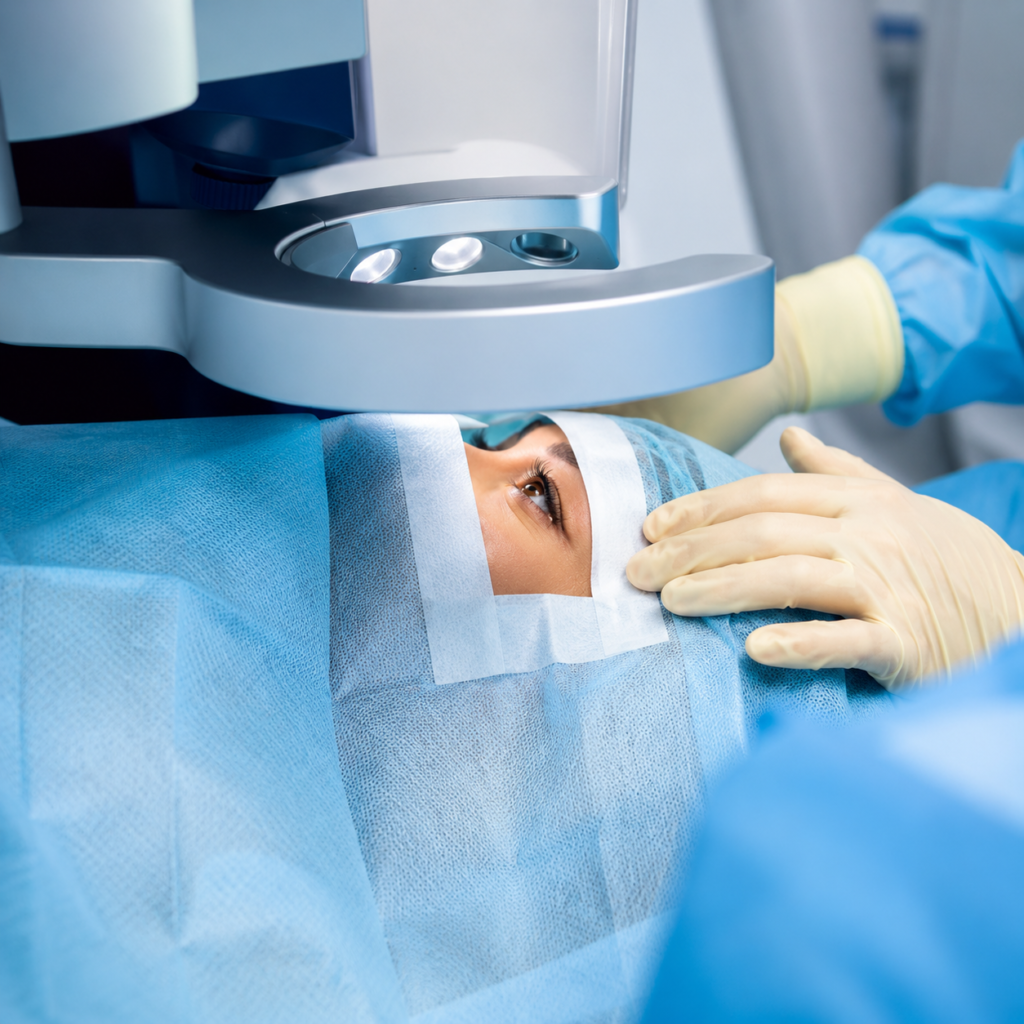
Implantable Collamer Lens (ICL) Surgery is an advanced vision correction procedure designed for people with moderate to high refractive errors who may not be suitable candidates for LASIK or other laser eye surgeries. During the procedure, a soft, biocompatible Collamer lens is implanted inside the eye, between the iris and the natural lens, to correct myopia (nearsightedness), hyperopia (farsightedness), and astigmatism. The natural lens remains in place, making the procedure reversible if required.

At our eye care center, we offer comprehensive ICL evaluations using advanced diagnostic technology to determine your suitability for the procedure. Our experienced refractive surgeons perform ICL surgery with precision and personalized care to deliver outstanding visual outcomes. The procedure is minimally invasive, virtually painless, and typically completed within 20–30 minutes. Most patients experience significantly improved vision within a few days and can return to normal activities shortly after surgery.

ICL surgery provides excellent visual quality, especially for patients with thin corneas, dry eyes, or high power prescriptions. It also offers UV protection and preserves the natural structure of the cornea.

The Eye Center Specialist
OUR TEAM

THE EYE CENTER SPECIALIST

Dr. Sonal Patel

MS Gold Medalist, DNB, FICO

Dr. Shachi Desai

MS, DNB, FURS, FAICO, FICO

Dr. Deep Joshi

MS, FICO Cataract & Glaucoma Surgeon

What is ICL surgery?

ICL (Implantable Collamer Lens) surgery is a vision correction procedure in which a soft artificial lens is implanted inside the eye to correct refractive errors without removing the natural lens.

The surgery usually takes 20–30 minutes for both eyes and is performed as a day-care procedure.

Many patients experience clearer vision within 24–48 hours, with vision continuing to stabilize over the following weeks.

As with any surgical procedure, there are potential risks such as infection, increased eye pressure, cataract formation, or glare. However, these complications are uncommon, and careful follow-up helps ensure a safe recovery.